featured
Why Magnesium Might Be the Missing Piece in Your Sleep Routine
Magnesium for sleep may support relaxation pathways like GABA and your wind-down routine. Explore the science and why Nightcap pairs it with reishi.

The Missing Piece in Your Sleep Routine
If you struggle with achieving deep sleep, you’re not alone. Modern life, with all of its racing thoughts, growing mental load, managing irregular schedules, and electronic light exposure, is making it increasingly harder to achieve good quality sleep. All of these factors can lead to circadian disruption. This refers to the body’s master clock, also known as your circadian rhythm. This internal timing system is responsible for signaling to your body when it is day and when it is night, helping you be alert in the morning and wind down before bed.
Without an aligned circadian rhythm, you’re left with not only sleep fragmentation and reduced sleep time, but overall poor sleep quality1. This is because your circadian rhythm is responsible for not only sleep and wake timing, but also body temperature, melatonin release, cortisol production, and mental alertness.
While adjusting your life circumstances is likely impossible, there are a few ways you can support your body’s natural circadian rhythm. One important way is to nourish the cellular processes that are involved in reaching deep sleep, by ensuring adequate intake of nutrients required. One essential example is magnesium.
What is Magnesium?
Magnesium is a mineral naturally occurring in many foods2, including quinoa, black beans, almonds, edamame, spinach, and more. Having a role in many cellular functions, magnesium is an essential mineral in the human diet, impacting brain, heart, bone, and muscle health.
While magnesium deficiency is uncommon, it can happen occasionally in certain demographics3. Those with digestive disorders, because of their inefficiencies in absorbing nutrients, can become deficient in magnesium. Likewise, those with diabetes often exhibit excessive magnesium loss due to insulin insensitivity. Additionally, those suffering from alcohol dependence may also experience deficiency. Because of this, these groups need to take extra care to ensure they are meeting their recommended daily amount through food and supplements.
Because magnesium has a role in so many bodily processes, adequate intake has been associated with many health benefits. It can help to lower blood pressure4, fight inflammation5, relieve constipation6, and even improve sleep7.

How Magnesium Initiates Sleep
So how does magnesium actually support healthy sleep? It does so in two ways. First, magnesium activates GABA receptors in the brain8, increasing GABA’s activity. This neurotransmitter is responsible for slowing brain signaling, quieting the mind, and promoting relaxation. The more GABA activity, the calmer you become.
While you are awake, your sympathetic nervous system is in control. Think of your sympathetic nervous system as a fast driving car. This is your “fight or flight” mode. You are alert, able to make quick decisions, and speeding through life’s daily challenges. GABA acts as the brake pedal to your nervous system. It slows down the anxiety and helps to initiate sleep.
In addition to increasing GABA’s activity, magnesium also has an indirect role in regulating melatonin9, which is a hormone that contributes to your circadian rhythm. Adequate intake of magnesium is key for the proper function of the pineal gland, which is where melatonin is produced and released.
Can Magnesium Improve Sleep Quality?
Research7 shows that magnesium intake is associated with an increased ability to drift off to sleep. This is mostly due to magnesium’s role in quieting the mind, increasing relaxation, thus preparing one for sleep. As you can imagine, this capacity for settling the mind is also important for reducing anxiety. In fact, research10 shows that magnesium may even be a helpful addition in anti-anxiety treatment.
Not only does magnesium help you get to sleep. It also helps you achieve deep sleep. In a study from 201211, researchers evaluated the impact of magnesium supplementation on sleep quality in 500 older adults. They found that the participants who took magnesium experienced significantly better sleep.
This information is not necessarily news. We’ve been studying magnesium’s influence on sleep for many years. In fact, back in 199312, researchers looked at how the deficiency of magnesium impacted sleep quality in mice. Results show that the mice with magnesium deficiency exhibited signs of lighter sleep when compared to those with adequate magnesium levels.

Magnesium in Nightcap
Treat yourself to restorative sleep with Nightcap. We created Nightcap as a way to achieve restful evenings, settle into deep sleep, and wake up feeling refreshed. It’s designed to slow the racing mind and deliver your deepest sleep ever.
We matched magnesium with the functional mushroom reishi, l-theanine, zinc, and chamomile - ingredients known for managing stress, helping you unwind, and promoting restful sleep cycles over time. This isn’t a sleeping pill. It’s a plan for nourishing your body’s sleep-promoting systems that compounds with daily intake.
When paired with l-theanine’s ability to increase alpha brain waves13, and chamomile’s ability to decrease cortisol output, Nightcap creates the environment for rejuvenating sleep to thrive. Calming your mind, reducing anxiety, and encouraging deeper, more restful sleep.

Bedtime Routine for Better Sleep
To achieve better sleep, set yourself up for success by developing a calming nighttime routine that gently guides you into slumber. First, take 1-2 squares of Nightcap to kick off this ritual. Then begin by closing your laptop, turning off the TV, and plugging in your phone away from your bed. This helps to reduce the blue light emissions as much as possible, which have been repeatedly associated14 with poor sleep quality.
Next, create a cozy environment, by turning off your overhead lights and any distracting sounds. Embrace the comfort by getting into breathable pajamas, curl up in bed, and participate in tranquil activities like reading or journaling.
By now, the magnesium is likely taking effect, helping to increase the GABA activity within your brain. You’ll begin to feel your thoughts quiet, your breathing slow, and your muscles relax. Meanwhile, the zinc is helping to raise your melatonin levels, while the reishi is reducing stress. Let your body drift away into sleep, knowing that it is being nurtured from within, fostering healthy sleep patterns.
Disclaimer: This blog contains promotional content about our products. The information provided is for educational purposes only and is not intended to diagnose, treat, cure, or prevent any disease. These statements have not been evaluated by the Food and Drug Administration. This content is not a substitute for medical advice. Always consult your healthcare provider before making changes to your wellness routine, especially if you are pregnant, nursing, taking medication, or have a medical condition.
References:
- Reddy S, Reddy V, Sharma S. Physiology, Circadian Rhythm. [Updated 2023 May 1]. In: StatPearls [Internet]. Treasure Island (FL): StatPearls Publishing; 2026 Jan-. Available from: https://www.ncbi.nlm.nih.gov/books/NBK519507/
- Jahnen-Dechent, W., & Ketteler, M. (2012). Magnesium basics. Clinical kidney journal, 5(Suppl 1), i3–i14. https://doi.org/10.1093/ndtplus/sfr163
- Magnesium - consumer - office of dietary supplements (ODS). (n.d.). https://ods.od.nih.gov/factsheets/Magnesium-Consumer/
- Guerrero-Romero, F., & Rodríguez-Morán, M. (2009). The effect of lowering blood pressure by magnesium supplementation in diabetic hypertensive adults with low serum magnesium levels: a randomized, double-blind, placebo-controlled clinical trial. Journal of human hypertension, 23(4), 245–251. https://doi.org/10.1038/jhh.2008.129
- Nielsen, F. H., Johnson, L. K., & Zeng, H. (2010). Magnesium supplementation improves indicators of low magnesium status and inflammatory stress in adults older than 51 years with poor quality sleep. Magnesium research, 23(4), 158–168. https://doi.org/10.1684/mrh.2010.0220
- Constipation & defecation problems: ACG. American College of Gastroenterology. (2024, October 23). https://gi.org/topics/constipation-and-defection-problems/
- Wienecke, E., & Nolden, C. (2016). Langzeit-HRV-Analyse zeigt Stressreduktion durch Magnesiumzufuhr [Long-term HRV analysis shows stress reduction by magnesium intake]. MMW Fortschritte der Medizin, 158(Suppl 6), 12–16. https://doi.org/10.1007/s15006-016-9054-7
- Poleszak E. (2008). Benzodiazepine/GABA(A) receptors are involved in magnesium-induced anxiolytic-like behavior in mice. Pharmacological reports : PR, 60(4), 483–489.
- Durlach, J., Pagès, N., Bac, P., Bara, M., & Guiet-Bara, A. (2002). Biorhythms and possible central regulation of magnesium status, phototherapy, darkness therapy and chronopathological forms of magnesium depletion. Magnesium research, 15(1-2), 49–66.
- Boyle, N. B., Lawton, C. L., & Dye, L. (2016). The effects of magnesium supplementation on subjective anxiety. The effects of magnesium supplementation on subjective anxiety. Magnesium research, 29(3), 120–125. https://doi.org/10.1684/mrh.2016.0411
- Abbasi, B., Kimiagar, M., Sadeghniiat, K., Shirazi, M. M., Hedayati, M., & Rashidkhani, B. (2012). The effect of magnesium supplementation on primary insomnia in elderly: A double-blind placebo-controlled clinical trial. Journal of research in medical sciences : the official journal of Isfahan University of Medical Sciences, 17(12), 1161–1169.
- Depoortere, H., Françon, D., & Llopis, J. (1993). Effects of a magnesium-deficient diet on sleep organization in rats. Neuropsychobiology, 27(4), 237–245. https://doi.org/10.1159/000118988
- Juneja, L. (1999a). L-theanine—a unique amino acid of green tea and its relaxation effect in humans. Trends in Food Science & Technology, 10(6–7), 199–204. https://doi.org/10.1016/s0924-2244(99)00044-8
- U.S. Department of Health and Human Services. (n.d.-a). Healthy sleep habits. National Heart Lung and Blood Institute. https://www.nhlbi.nih.gov/health/sleep-deprivation/healthy-sleep-habits

By Kristen Carli, MS, RD
Kristen Carli is the owner of Camelback Nutrition & Wellness, a private nutrition practice and consulting firm. She graduated from University of Arizona with a BA in psychology and then received a BS in dietetics from Arizona State University. After completion of the dietetic internship, she continued her education by receiving a MS in Human Nutrition from University of Western States. Having a passion for nutrition communication, she writes for many food and nutrition outlets as well as regularly develops recipes for food brands and media companies. Her nutrition expertise has been featured in InStyle, Bustle, Livestrong, The List, MyFitnessPal and many others. Additionally, Kristen is often featured via local TV segments sharing nutrition tips and tricks. She was selected to act as a Produce for Better Health Foundation Fruit and Vegetable Ambassador in Action, helping to promote the health benefits and importance of consuming fruits and vegetables, as well as a FoodMinds upwaRD winner for 2022, honoring up and coming media dietitians. You can find her reading, running, and exploring new restaurants with her husband and baby boy.
save 15% with code alice15
Nightcap







Nightcap
Select Quantity:
Choose Your Price:

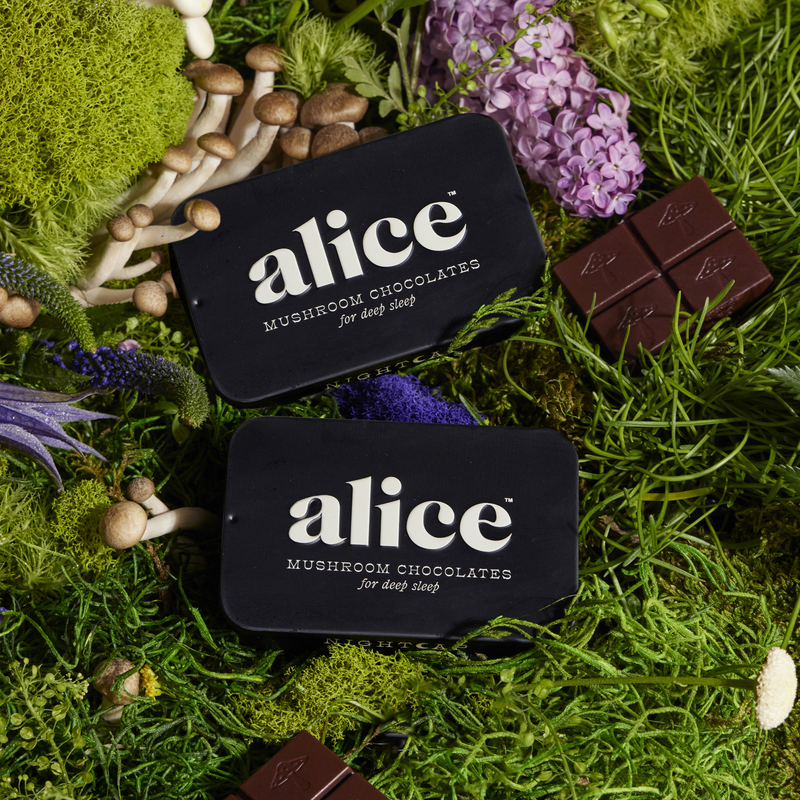
Nightcap contains fairly traded organic dark chocolate, organic Reishi from 100% fruiting body mushrooms, chamomile, L-theanine, magnesium malate, and zinc citrate.
Vegan, gluten-free, dairy-free, and OU-D kosher certified.
Other ingredients: organic semi-sweet 72% dark chocolate (organic unsweetened chocolate, organic cane sugar, organic cocoa butter), coconut oil, cocoa butter
Allergens: Coconut, Soy
Processed on shared equipment and may contain peanuts, tree nuts, milk, eggs, or soy.
Nightcap is formulated with Reishi mushrooms to regulate sleep cycles and support stress levels, while also delivering an immediate feeling of nighttime relaxation from magnesium malate, l-theanine, zinc, and chamomile.
The real magic is in the long term benefits of the Reishi mushroom which, when taken regularly for about 3 weeks, can help manage stress levels and improve overall sleep cycles by down-regulating the nervous system.
Zinc and magnesium have been shown to increase the body’s levels of naturally circulating melatonin to regulate your circadian rhythm from within. Zinc has also been shown to quiet the mind after periods of mental stress.
Chamomile has long been used in calming nighttime rituals, while reishi's adaptogenic roots are linked to relaxation and overall balance. Together, they help set the stage for restful nights and refreshed mornings.
Magnesium is often associated with helping the body relax and ease into rest, while l-theanine is connected to a calm, balanced state by influencing mood-supportive neurotransmitters.
What to expect:
- In 30 minutes, fall asleep easier and sleep better
- In 30 days, notice restful sleep, sleep through the night, and experience a faster sleep onset
- After 3 months, enjoy healthy sleep cycles, increased sleep quality, and wake up rested
One square suits most.
Eat 1-2 squares of Nightcap an hour before bedtime to support sleep and relaxation. With nightly use, Nightcap will help to foster healthy sleep patterns and deeper sleep.
We exclusively use organic, fruiting body Reishi mushrooms that are hand-harvested when their medicinal compounds are at peak concentration. Our mushrooms are dried in the sun to soak up Vitamin D before undergoing a pure, starch-free extraction process.
All ingredients are third-party lab tested for safety and stability, and mushrooms are third-party lab tested for potency.
