featured
Sleep Routine 101
Your best sleep starts with morning habits. Use this sleep routine timeline to set your body clock all day, and make wind-down feel easier.

Sleep Routine 101
It sounds surprising, but a great night’s sleep begins the moment you greet the morning sun. Our body is governed by a tiny, light-sensitive structure in the brain called the suprachiasmatic nucleus (SCN).¹ This acts as your circadian pacemaker, regulating body temperature, 24-hour sleep-wake cycles, and hormone release.
When morning light hits the specialized cells in your eyes, it sets the hormonal countdown. Which then triggers a natural stress peak that determines exactly when your melatonin will begin to rise 14 hours later. If you aren’t stepping outside before 10 AM, your internal clock is essentially thrown off. The goal is to tell your body where it is in time, not just to tap a button on your alarm clock.
The Caffeine Window
From the moment you wake up, a chemical called adenosine builds up in your brain. Think of it as “sleep pressure”, the longer you are awake, the more it accumulates, eventually signaling to the brain that it’s time to wind down.
Caffeine doesn't actually give you energy, it simply masks the “tired” signal by blocking those receptors. To protect your sleep, the caffeine cutoff is non-negotiable. Caffeine can last in your body about six hours, which means that a 4 PM espresso shot is still circulating in your system at 10 PM, silently ruining your evening relaxation. In order to set yourself up for success, aim to finish your last cup of coffee or matcha by noon, or at the latest, eight hours before you plan on going to bed.

The Metabolic Link: Blood Sugar Spikes
What we eat, and when, is a crucial part of the circadian puzzle. Your liver and gut have their own internal clocks that are extremely sensitive to insulin spikes.² When we eat a heavy sugar-laden meal late at night, we trigger a surge in cortisol and a dip in growth hormone, which is usually at its peak during the first half of the night for physical repair.
Maintaining stable blood sugar levels throughout the day can reduce the odds of the 3 AM wake-up call. When blood sugar crashes in the middle of the night, the body releases adrenaline and cortisol to stabilize it, effectively jolting you out of deep REM sleep.³
Sleep Routine Timeline
Let’s walk through what a day of things you can do to set yourself up for a successful sleep routine.
6:00 AM: Morning sunlight. According to Dr. Matthew Walker, a world-renowned neuroscientist and author of Why We Sleep, getting direct sunlight into your eyes first thing in the morning is the single most important habit for regulating your sleep-wake cycle.⁴ When you step outside, photons hit the melanopsin-containing ganglion cells in your retina. These cells send direct signals to your brain that the day has officially begun.
8:00 AM: The most critical window for blood sugar control is in your first meal. Have you ever noticed when you are running out the door in the morning, and the only thing you can think of having is a coffee loaded with different milks and heavy sweeteners? That is a hormonal recipe for disaster. Opt for a breakfast rich in proteins, healthy fats, and fiber - then you can have your coffee. This creates a steady glucose response that ensures a steady release of energy rather than a sharp spike followed by a mid-morning crash.
11:00 AM: The caffeine buffer. If you’re reaching for a third cup of coffee, pair it with a small handful of nuts or a few olives. Caffeine on an empty stomach can trigger a temporary spike in blood sugar by stimulating the release of adrenaline, which tells the liver to dump stored glucose into the bloodstream.⁵ Providing a small amount of fat or fiber buffers this response, keeping your insulin levels stable.
1:00 PM: The fiber first rule. When sitting down to eat, order of operations matters. Research into “food sequencing” (specifically in those with gestational diabetes) shows that eating your fiber (greens or non-starchy vegetables) and protein before your complex carbohydrates can reduce your post-meal glucose spike by 75%. Start with the veggies before moving to your main dish, this slows down the absorption of sugars into the bloodstream.⁶
4:00 PM: Go for a walk. A brisk 10-15 minute walk after any meal allows your muscles to soak up excess glucose without needing a massive surge of insulin. It is the simplest “metabolic reset” available to us.
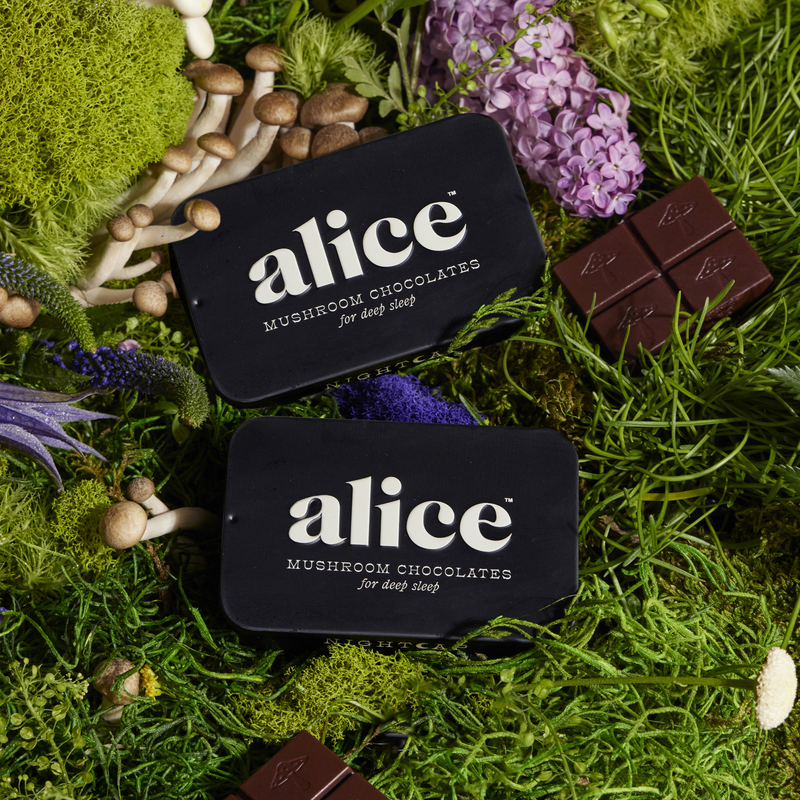
7:00 PM: The evening taper. As the sun goes down, your insulin sensitivity naturally decreases. This is your body’s way of preparing for the midnight cleanse. Eating a heavy, carbohydrate-dense meal late at night forces the body to focus on digestion and insulin management rather than cellular repair. If you’re craving a late-night sweet treat, this is the ideal time for an Alice Nightcap. The dark chocolate provides the sweetness of a decadent dessert without the glycemic overload, while the reishi, magnesium, and l-theanine begin to support a smoother transition into rest.
The Thermal Reset
There is a profound biological reason why we crave crisp linen and cool air. To initiate the transition into deep rest, your core body temperature must drop by roughly 2-3°F. Your brain won’t allow you access to a deep stage of sleep if it's too busy trying to cool your core.⁷
This is why a warm Epsom salt bath an hour before bed really feels like magic. It’s called “distal vasodilation." By warming your hands and feet, you force your body to dump heat from its core. You are supporting a thermal runway for your brain to check out. Pair this with a room kept cool at 66°F, and you’ve cleared the primary hurdle to good sleep.

Why Do We Actually Need Sleep?
Why do we actually need to basically vanish for eight hours? Because the brain needs to wash itself. While you are in a deep, non-REM sleep, the glymphatic system (a recently discovered waste-clearance network) becomes ten times more active.⁸
During these deep-sleep waves, research has shown that the space between your brain cells can expand, allowing cerebrospinal fluid to flush through and clear out the metabolic debris that accumulates during the day.⁸ This process is associated with emotional patience and our personal edge. When we cut sleep short, we aren’t just tired; we are neurologically cluttered.
The Morning-After Effect
The true metric of a successful sleep routine is how you feel at 8 AM. When everything aligns; your environment, your nutrition, and your ritual with your biology, you stop waking up exhausted and start waking up ready to take on the day.
When we treat sleep as a true 24-hour art form, we reclaim the most sophisticated technology we possess: our own bodies.

Disclaimer: This blog contains promotional content about our products. The information provided is for educational purposes only and is not intended to diagnose, treat, cure, or prevent any disease. These statements have not been evaluated by the Food and Drug Administration. This content is not a substitute for medical advice. Always consult your healthcare provider before making changes to your wellness routine, especially if you are pregnant, nursing, taking medication, or have a medical condition.
References:
- Dr. Ravi Kumar MD. (2025). Your Brain's Master Clock: How the Suprachiasmatic Nucleus Controls Circadian Rhythms. Retrieved from https://drkumardiscovery.com/posts/transplanted-suprachiasmatic-nucleus-determines-circadian-period/
- Stenvers, D. J., Scheer, F. A. J. L., Schrauwen, P., la Fleur, S. E., & Kalsbeek, A. (2019). Circadian clocks and insulin resistance. Nature reviews. Endocrinology, 15(2), 75–89. Retrieved from https://doi.org/10.1038/s41574-018-0122-1
- Michigan Medicine - University of Michigan. (2025, August 24). Your brain works overtime at night to burn fat and prevent sugar crashes. ScienceDaily. Retrieved from www.sciencedaily.com/releases/2025/08/250824031536.htm
- Walker, M. (2017). Books: Why We Sleep: Unlocking the Power of Sleep and Dreams: Retrieved from https://doi.org/10.3399/bjgp18X695609
- Lovallo, W. R., Whitsett, T. L., al'Absi, M., Sung, B. H., Vincent, A. S., & Wilson, M. F. (2005). Caffeine stimulation of cortisol secretion across the waking hours in relation to caffeine intake levels. Psychosomatic medicine, 67(5), 734–739. Retrieved from https://doi.org/10.1097/01.psy.0000181270.20036.06
- Xega, V., & Liu, J. L. (2025). Chrononutrition in Gestational Diabetes: Toward Precision Timing in Maternal Care. Journal of personalized medicine, 15(11), 534. Retrieved from https://doi.org/10.3390/jpm15110534
- Harding, E. C., Franks, N. P., & Wisden, W. (2019). The Temperature Dependence of Sleep. Frontiers in neuroscience, 13, 336. Retrieved from https://doi.org/10.3389/fnins.2019.00336
- Reddy, O. C., & van der Werf, Y. D. (2020). The Sleeping Brain: Harnessing the Power of the Glymphatic System through Lifestyle Choices. Brain sciences, 10(11), 868. https://doi.org/10.3390/brainsci10110868

By Kristen Carli, MS, RD
Kristen Carli is the owner of Camelback Nutrition & Wellness, a private nutrition practice and consulting firm. She graduated from University of Arizona with a BA in psychology and then received a BS in dietetics from Arizona State University. After completion of the dietetic internship, she continued her education by receiving a MS in Human Nutrition from University of Western States. Having a passion for nutrition communication, she writes for many food and nutrition outlets as well as regularly develops recipes for food brands and media companies. Her nutrition expertise has been featured in InStyle, Bustle, Livestrong, The List, MyFitnessPal and many others. Additionally, Kristen is often featured via local TV segments sharing nutrition tips and tricks. She was selected to act as a Produce for Better Health Foundation Fruit and Vegetable Ambassador in Action, helping to promote the health benefits and importance of consuming fruits and vegetables, as well as a FoodMinds upwaRD winner for 2022, honoring up and coming media dietitians. You can find her reading, running, and exploring new restaurants with her husband and baby boy.
save 15% with code alice15
Nightcap







Nightcap
Select Quantity:
Choose Your Price:

Nightcap contains fairly traded organic dark chocolate, organic Reishi from 100% fruiting body mushrooms, chamomile, L-theanine, magnesium malate, and zinc citrate.
Vegan, gluten-free, dairy-free, and OU-D kosher certified.
Other ingredients: organic semi-sweet 72% dark chocolate (organic unsweetened chocolate, organic cane sugar, organic cocoa butter), coconut oil, cocoa butter
Allergens: Coconut, Soy
Processed on shared equipment and may contain peanuts, tree nuts, milk, eggs, or soy.
Nightcap is formulated with Reishi mushrooms to regulate sleep cycles and support stress levels, while also delivering an immediate feeling of nighttime relaxation from magnesium malate, l-theanine, zinc, and chamomile.
The real magic is in the long term benefits of the Reishi mushroom which, when taken regularly for about 3 weeks, can help manage stress levels and improve overall sleep cycles by down-regulating the nervous system.
Zinc and magnesium have been shown to increase the body’s levels of naturally circulating melatonin to regulate your circadian rhythm from within. Zinc has also been shown to quiet the mind after periods of mental stress.
Chamomile has long been used in calming nighttime rituals, while reishi's adaptogenic roots are linked to relaxation and overall balance. Together, they help set the stage for restful nights and refreshed mornings.
Magnesium is often associated with helping the body relax and ease into rest, while l-theanine is connected to a calm, balanced state by influencing mood-supportive neurotransmitters.
What to expect:
- In 30 minutes, fall asleep easier and sleep better
- In 30 days, notice restful sleep, sleep through the night, and experience a faster sleep onset
- After 3 months, enjoy healthy sleep cycles, increased sleep quality, and wake up rested
One square suits most.
Eat 1-2 squares of Nightcap an hour before bedtime to support sleep and relaxation. With nightly use, Nightcap will help to foster healthy sleep patterns and deeper sleep.
We exclusively use organic, fruiting body Reishi mushrooms that are hand-harvested when their medicinal compounds are at peak concentration. Our mushrooms are dried in the sun to soak up Vitamin D before undergoing a pure, starch-free extraction process.
All ingredients are third-party lab tested for safety and stability, and mushrooms are third-party lab tested for potency.
