featured
Melatonin for Sleep: What It Is & When to Be Cautious
Melatonin for sleep isn’t a vitamin - it’s a hormone. Learn serving size pitfalls, “tired but wired” cortisol issues, and when to be cautious.

Melatonin for Sleep
We’ve all been there. It’s 11:30 PM, your brain is still vibrating from a late night scroll, and the melatonin gummy on your nightstand feels like the only way out. For years, melatonin for sleep has been marketed as the ultimate “get out of jail free” card for the restless. People think it’s a harmless, natural vitamin that flips the switch on sleeplessness.
But here is the truth the wellness industry rarely mentions: melatonin isn’t a vitamin. It’s a potent hormone. And by treating it like a casual nightly ritual, we might be overriding the very issue we’re trying to fix.
Produced by the pineal gland in response to darkness, melatonin is the brain’s “vampire hormone,” a chemical signal that coordinates the body’s circadian rhythm.¹
Melatonin (the hormone, not the gummy) manages the drop in core body temperature and the shift in blood pressure required for rest. When we take a massive, “knock-out” dose, we aren’t just nudging the body to go to sleep; we’re screaming at it.
The Dosage Dilemma: Why More is Often Less
Perhaps the most startling reality of the melatonin market is the sheer scale of dosage. The human body naturally produces a microscopic amount of the hormone, typically around 0.3mg.² Yet, if you take a look at any pharmacy shelf, you’ll see melatonin gummies that contain doses of 5mg, 10mg, or even 20mg.
Taking hundreds of times more than your natural production doesn’t necessarily result in better sleep; instead, it often leads to the “melatonin hangover” – that heavy brain-fogged irritability the next morning.3 Research from the Journal of Clinical Sleep Medicine reported that over-the-counter options can vary by as much as 478% more hormone than what is listed on the label.4

"Tired but Wired"
One of the most common reasons melatonin for sleep fails is a misunderstanding of why we aren’t sleeping in the first place. If your sleep issues are driven by stress or “tired but wired” syndrome, your problem probably isn’t a lack of melatonin, it would just be an excess of cortisol.5
Cortisol and melatonin exist on an inverse see-saw. When cortisol is high, it actively suppresses the body’s ability to utilize melatonin. Adding more melatonin to a high-stress system is that spike of cortisol from a stressful day, melatonin is essentially almost useless. You can’t force sleep if your stress response isn’t regulated. The hormone cannot override the biological “alert” signal of a stressed nervous system.
When to Be Cautious: The Red Flags
While melatonin may be helpful for specific issues, like jet lag, it is not a universal solution for restlessness. Recent data has introduced new layers of caution:
● Hormonal Overlap: Because it is an endocrine signal, melatonin can interact with hormonal contraceptives.⁴ Since birth control can already elevate natural melatonin levels, adding a supplement can lead to over-saturation and disrupted cycles.
● The Heart Connection: research presented at the American Heart Association's 2025 Scientific Sessions suggested a potential link between sustained, high-dose melatonin use and increased risks to cardiovascular stability in certain populations.⁵ While not definitive, it highlights the importance of hormones, and how they should be treated delicately and not just as a casual candy.
● Drug Interactions: Melatonin can interact with certain medications and may not be right for everyone, especially if you take blood pressure meds or manage blood sugar. It’s always important to consult your doctor before starting any new over-the-counter medication or dietary supplements.⁶

The Square that Caps Off the Night
At Alice, we’ve swapped out melatonin for a more sophisticated and natural blend of botanicals and minerals that support the nervous system’s natural transition into rest.
● Reishi: Reishi supports healthy sleep by influencing GABA activity - which is the neurotransmitter that acts as the brain’s natural brake pedal.⁷ It also supports levels of 5-HTP, a crucial precursor to your body’s own natural serotonin and melatonin.
● L-theanine: Found in tea leaves, l-theanine creates a state of calm. A quiet mental space that supports a transition into sleep without the “knock-out” effect of sedatives.
● Magnesium & Zinc: These minerals are known to help support the pineal gland. Magnesium specifically supports the activity of N-acetyltransferase, the key enzyme that helps convert serotonin into melatonin naturally. ⁸
Rest is the ultimate luxury, and it deserves a ritual that is as clean in ingredients as it is intentional. Nightcap is crafted from organic, fair-trade dark chocolate, and is a 30-calorie functional treat. Ensuring that what you’re putting into your body is as pure as the sleep you’re so desperately trying to achieve.

Your 90-Minute Night Routine
- T-Minus 90: Dim the lights in your home, switch your blue-light emitting devices to “do not disturb” and then put them away. This helps cue your body that night is starting and to begin the process of allowing melatonin to begin its natural rise.
- T-Minus 60: Take 1 to 2 squares of Nightcap. A little nightly sweet treat that acts as a mindful communicator to your brain that the “doing” part of the day is over.
- T-Minus 30: As the reishi and l-theanine begin to support the wind-down process, engage in low-stimulation activity. A warm bath, light stretching, or journaling helps move the body from the sympathetic (fight or flight) state into the parasympathetic (rest and digest) state.
- T-Minus 15: Wash your face, put on your favorite creams and serums, throw on your comfiest pajamas. Build a ritual that signals to your body every day, “okay it’s time to relax now.”
- T-Minus 0: Slide into bed, and let the rest and recovery begin.
As any longevity or health expert will tell you, sleep is the single most important variable in the human equation.9 It is the baseline for everything. If you aren’t sleeping, you are playing the game of life. From metabolic health and weight management to the cognitive sharpness required for a high-stakes meeting you have tomorrow, it all begins to erode. Even our emotional intelligence suffers; the ability to be a present, patient friend or partner is a byproduct of a rested and calm nervous system.
Sleep is the fuel for the life you want to live. Don’t ignore your body’s signals with a sledgehammer of hormones. And before reaching for melatonin for sleep, ask yourself: why force a ‘shut down’ when you could simply nourish your body’s rest naturally?
Disclaimer: This blog contains promotional content about our products. The information provided is for educational purposes only and is not intended to diagnose, treat, cure, or prevent any disease. These statements have not been evaluated by the Food and Drug Administration. This content is not a substitute for medical advice. Always consult your healthcare provider before making changes to your wellness routine, especially if you are pregnant, nursing, taking medication, or have a medical condition.
References:
- Matthew Walker. (2017). Why We Sleep. ISBN: 978-0-241-26906-0. Retrieved from https://icrrd.com/public/media/16-05-2021-080425Why-We-Sleep-Unlocking-the-Power-of-Sleep.pdf
- Costello, R. B., Lentino, C. V., Boyd, C. C., O'Connell, M. L., Crawford, C. C., Sprengel, M. L., & Deuster, P. A. (2014). The effectiveness of melatonin for promoting healthy sleep: a rapid evidence assessment of the literature. Nutrition journal, 13, 106. Retrieved from https://doi.org/10.1186/1475-2891-13-106
- Besag, F. M. C., Vasey, M. J., Lao, K. S. J., & Wong, I. C. K. (2019). Adverse Events Associated with Melatonin for the Treatment of Primary or Secondary Sleep Disorders: A Systematic Review. CNS drugs, 33(12), 1167–1186. https://doi.org/10.1007/s40263-019-00680-w
- Wright, K. P., Jr, & Badia, P. (1999). Effects of menstrual cycle phase and oral contraceptives on alertness, cognitive performance, and circadian rhythms during sleep deprivation. Behavioural brain research, 103(2), 185–194. https://doi.org/10.1016/s0166-4328(99)00042-x
- Grigg-Damberger, M. M., & Ianakieva, D. (2017). Poor Quality Control of Over-the-Counter Melatonin: What They Say Is Often Not What You Get. Journal of clinical sleep medicine : JCSM : official publication of the American Academy of Sleep Medicine, 13(2), 163–165. https://doi.org/10.5664/jcsm.6434
- Nicolaides NC, Vgontzas AN, Kritikou I, et al. HPA Axis and Sleep. [Updated 2020 Nov 24]. In: Feingold KR, Adler RA, Ahmed SF, et al., editors. Endotext [Internet]. South Dartmouth (MA): MDText.com, Inc.; 2000-. Available from: https://www.ncbi.nlm.nih.gov/books/NBK279071/
- The American Heart Association. American Heart Association Scientific Sessions (2025). Sustained use of melatonin supplements to support sleep may have negative health effects. Retrieved from https://newsroom.heart.org/news/long-term-use-of-melatonin-supplements-to-support-sleep-may-have-negative-health-effects
- Garaulet, M., Qian, J., Florez, J. C., Arendt, J., Saxena, R., & Scheer, F. A. J. L. (2020). Melatonin Effects on Glucose Metabolism: Time To Unlock the Controversy. Trends in endocrinology and metabolism: TEM, 31(3), 192–204. https://doi.org/10.1016/j.tem.2019.11.011
- Yao, C., Wang, Z., Jiang, H., Yan, R., Huang, Q., Wang, Y., Xie, H., Zou, Y., Yu, Y., & Lv, L. (2021). Ganoderma lucidum promotes sleep through a gut microbiota-dependent and serotonin-involved pathway in mice. Scientific reports, 11(1), 13660. https://doi.org/10.1038/s41598-021-92913-6
- Morton, D. J., & James, M. F. (1985). Effect of magnesium ions on rat pineal N-acetyltransferase (EC 2.3.1.5) activity. Journal of pineal research, 2(4), 387–391. https://doi.org/10.1111/j.1600-079x.1985.tb00718.x
- Walker, M. (2017). Books: Why We Sleep: Unlocking the Power of Sleep and Dreams. Retrieved from https://doi.org/10.3399/bjgp18X695609

By Kristen Carli, MS, RD
Kristen Carli is the owner of Camelback Nutrition & Wellness, a private nutrition practice and consulting firm. She graduated from University of Arizona with a BA in psychology and then received a BS in dietetics from Arizona State University. After completion of the dietetic internship, she continued her education by receiving a MS in Human Nutrition from University of Western States. Having a passion for nutrition communication, she writes for many food and nutrition outlets as well as regularly develops recipes for food brands and media companies. Her nutrition expertise has been featured in InStyle, Bustle, Livestrong, The List, MyFitnessPal and many others. Additionally, Kristen is often featured via local TV segments sharing nutrition tips and tricks. She was selected to act as a Produce for Better Health Foundation Fruit and Vegetable Ambassador in Action, helping to promote the health benefits and importance of consuming fruits and vegetables, as well as a FoodMinds upwaRD winner for 2022, honoring up and coming media dietitians. You can find her reading, running, and exploring new restaurants with her husband and baby boy.
save 15% with code alice15
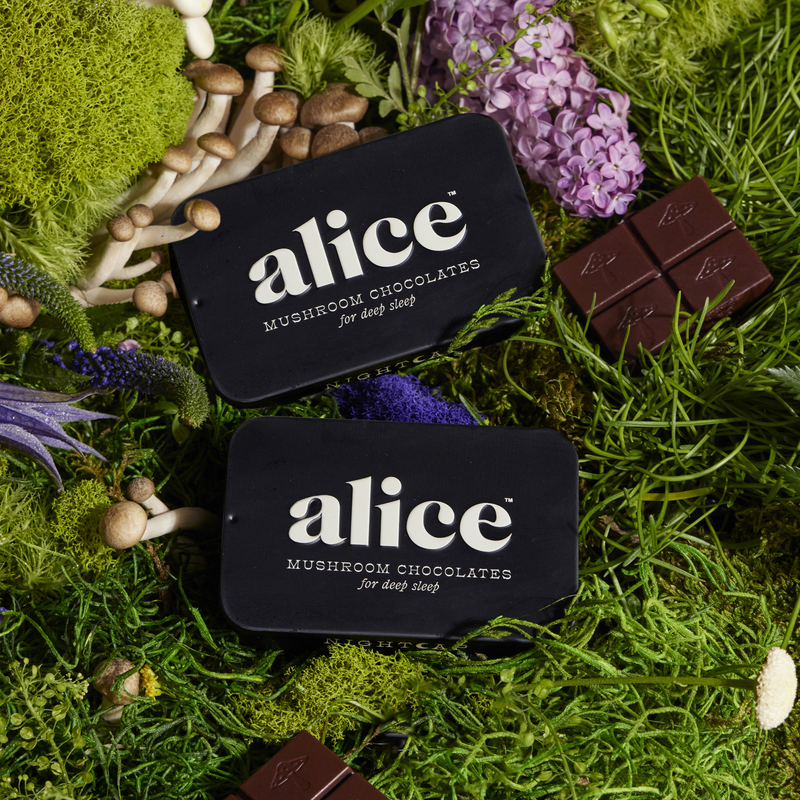
Nightcap







Nightcap
Select Quantity:
Choose Your Price:

*$10 surcharge on all orders to FL, TX, AZ, HI. $9.99 shipping on one-time orders.
final shipping cost shown at checkout.
Nightcap contains fairly traded organic dark chocolate, organic Reishi from 100% fruiting body mushrooms, chamomile, L-theanine, magnesium malate, and zinc citrate.
Vegan, gluten-free, dairy-free, and OU-D kosher certified.
Other ingredients: organic semi-sweet 72% dark chocolate (organic unsweetened chocolate, organic cane sugar, organic cocoa butter), coconut oil, cocoa butter
Allergens: Coconut, Soy
Processed on shared equipment and may contain peanuts, tree nuts, milk, eggs, or soy.
Nightcap is formulated with Reishi mushrooms to regulate sleep cycles and support stress levels, while also delivering an immediate feeling of nighttime relaxation from magnesium malate, l-theanine, zinc, and chamomile.
The real magic is in the long term benefits of the Reishi mushroom which, when taken regularly for about 3 weeks, can help manage stress levels and improve overall sleep cycles by down-regulating the nervous system.
Zinc and magnesium have been shown to increase the body’s levels of naturally circulating melatonin to regulate your circadian rhythm from within. Zinc has also been shown to quiet the mind after periods of mental stress.
Chamomile has long been used in calming nighttime rituals, while reishi's adaptogenic roots are linked to relaxation and overall balance. Together, they help set the stage for restful nights and refreshed mornings.
Magnesium is often associated with helping the body relax and ease into rest, while l-theanine is connected to a calm, balanced state by influencing mood-supportive neurotransmitters.
What to expect:
- In 30 minutes, fall asleep easier and sleep better
- In 30 days, notice restful sleep, sleep through the night, and experience a faster sleep onset
- After 3 months, enjoy healthy sleep cycles, increased sleep quality, and wake up rested
One square suits most.
Eat 1-2 squares of Nightcap an hour before bedtime to support sleep and relaxation. With nightly use, Nightcap will help to foster healthy sleep patterns and deeper sleep.
We exclusively use organic, fruiting body Reishi mushrooms that are hand-harvested when their medicinal compounds are at peak concentration. Our mushrooms are dried in the sun to soak up Vitamin D before undergoing a pure, starch-free extraction process.
All ingredients are third-party lab tested for safety and stability, and mushrooms are third-party lab tested for potency.
