featured
Lion’s Mane: The Brain Mushroom
Meet lion’s mane, the brain mushroom. Learn how it may support productivity, mental clarity, and overall cognitive wellness without the jittery “on” switch.

Lion’s Mane: The Brain Mushroom
Lion’s Mane has been a slow burn in the wellness industry. One day it was niche, the kind of woo woo ingredient you have to overexplain. The next, it was everywhere; blended into smoothies at every juice bar in Venice, scribbled onto café menus next to oat milk, and stocked on shelves in wellness shops between matcha tins and magnesium powders. It’s now a wellness staple.
Most wellness trends are wrapped in overpromises and underdelivery, Lion’s Mane is the opposite. It gained traction at a moment when mental fatigue had become so common it no longer needed a diagnosis. Productivity felt harder to hold and attention span grew thinner. Even a rest day doesn’t seem to hit like it used to.
Rather than promising to sharpen the mind or push it into overdrive, Lion’s mane offered a new idea: support instead of stimulation. The brain doesn’t need more force, instead it functions better with steadier more intentional care. In a culture built around needing everything done immediately, this felt different.
Plenty of wellness supplements peak and disappear. Lion’s Mane didn’t. It became an old reliable – something people kept returning to long after the novelty wore off.
Long Before It Was a Wellness Staple
Lion's Mane is a strange-looking mushroom, even by mushroom standards. Instead of caps and stems, it grows in soft, cascading spins that hang from hardwood trees, more under-the-sea coral look over fungus. It has been used in Japan and China for centuries: simmered into broth, brewed into teas, and eaten as part of everyday meals. In monasteries, it has been known to be used during meditation to quiet down distractions. Lion’s Mane is steady, supporting productivity, calming, mental noise, and sustaining attention over time.
Other mushrooms made their way into the natural health community circles earlier, often through bitter extracts and overtly medicinal framing that fit the ideas of early alternative health movements. Lion’s Mane, despite being gentle and genuinely enjoyable to eat, stayed in the background. As science did more research on natural ways to boost attention, memory, and cognitive endurance, Lion’s Mane began to feel newly relevant.

The Research, So Far
Researchers studying Lion’s Mane began isolating two groups of compounds that are relatively rare in nature: hericenones and erinacines. What stood out about these compounds was their relationship to nerve growth factor, often referred to as NGF. NGF is a protein that plays a crucial role in the growth, maintenance, and survival of neurons, particularly in areas of the brain tied to learning, memory, and cognition.
NGF isn’t a wellness buzzword. It’s one of the nervous system's most important molecules. It helps neurons grow, repair themselves, and maintain the connections that allow the brain to communicate efficiently. NGF’s discovery reshaped modern neuroscience and earned a Nobel Prize, in part because it revealed that the brain is far more dynamic and adaptable than once believed.
What made Lion’s Mane compelling was not that it acted like a stimulant or mimicked NGF directly, but that its compounds appeared to support the body’s own production and regulation of NGF. In studies with animals, Lion’s Mane extracts were shown to increase NGF expression and support neuronal growth. From there, researchers began exploring its role in neuroplasticity (the brain's ability to form new connections and adapt over time).
Human research is still emerging, but it’s notable. A small Japanese clinical study followed older adults with mild cognitive impairment who consumed Lion’s Mane daily over several months. Participants showed measurable improvements in cognitive performance during the observed period. The study was limited in size and scope, and it didn’t claim permanent change, but that detail is important. Think of ongoing support rather than a one-time intervention.
Lion’s Mane is in a different category than caffeine or fast-acting nootropics. There’s no spoke, no forced alertness, no immediate “on” switch. Instead, the proposed benefits align with a slower process: maintenance of the neurons, efficient brain signaling, and sustained brain health.
The Kind of Clarity You Notice Later
One of the most common misconceptions about Lion’s Mane is how it’s supposed to feel. There’s no moment where the brain suddenly clicks into overdrive. No immediate brain surge, no sharpened edge.
Cognitive fatigue doesn’t always show up as tiredness. Some days it feels more like distance. You know the days when the brain fog is so heavy you feel slightly detached; moving through the motions on autopilot, unsure how you got from one moment to the next. It’s the thinking that feels heavier than it should. That’s where Lion’s Mane comes in. Having thoughts becomes less effort, and staying present requires less strain.

What The Brain Actually Responds To
Despite how much we try to trick our brains into thinking we’re going to have a productive day – by relying on four shots of espresso, a packed to-do list, and sheer momentum, the brain simply doesn’t respond well to that. Sure, stimulation can create the feeling of alertness, but it doesn’t necessarily support the system's responsibility for clarity, focus, or cognitive endurance.
Biologically, productivity isn’t about pushing the body harder. It responds better to efficiency: how well the brain neurons communicate, how resilient the body is under stress, and how well the brain is treated over time. When all nervous systems are taxed, the body and mind start to shut down, causing fatigue and a mental focus that requires constant effort.
When Lion’s Mane becomes part of a daily routine, consistency matters. Repeated exposure to the same supportive inputs may help maintain conditions associated with stable cognitive function over time.
How We Think About Lion’s Mane at alice
Instead of treating Lion’s Mane like an add-on to a cappuccino or something you sprinkle in when you remember, we think about it as the main course.
Not in the sense of doing more, but in doing it properly. Ingredients that work cumulatively don’t respond to casual use. They respond to repetition that you can enjoy. That’s why we’re less interested in positioning Lion’s Mane as a fix for an off day and more interested in what happens when it becomes part of a baseline. When you feed your brain regularly, it doesn’t have to compensate as much.
This way of thinking shaped how we approached Brainstorm. The goal wasn’t to manufacture focus or override fatigue, but to support the pathways that allow clarity to emerge more reliably over time. Something the brain can integrate rather than react to, making the brain's job even easier.
Formulated with Lion’s Mane, Cordyceps, Guarana, and Phosphatidylserine, Brainstorm reflects the reality that cognitive function is multi-dimensional. Lion’s Mane supports sustained brain health and adaptability. Cordyceps helps sustain mental energy, so focus doesn’t fade as the day goes on. Guarana gives a steady lift in alertness, without the crashes of synthetic stimulants. Phosphatidylserine supports how brain cells communicate, making thoughts feel smoother and less effortful under pressure.
This isn’t about getting more out of your brain. It’s about asking it to do less.

Thinking About the Brain
We’re only touching the surface of how modern life taxes the brain. Constant stimulation. Fragmented attention. Long stretches of brain demand without meaningful recovery. It makes sense that ingredients rooted in maintenance are gaining traction. They reflect a shift toward longevity.
That’s why Lion's Mane fits exactly into what we do at Alice. Not as a caffeine jolt, but a broader support for your brain day to day. Consistency over intensity that isn’t sustainable. A formulation designed to quiet the mind, not add to it.
Disclaimer: This blog contains promotional content about our products. The information provided is for educational purposes only and is not intended to diagnose, treat, cure, or prevent any disease. These statements have not been evaluated by the Food and Drug Administration. This content is not a substitute for medical advice. Always consult your healthcare provider before making changes to your wellness routine, especially if you are pregnant, nursing, taking medication, or have a medical condition.
References:
- Cleveland Clinic. (2024). Health Benefits of Lion’s Mane Mushrooms. Retrieved from https://health.clevelandclinic.org/lions-mane-mushrooms-benefits
- WebMD. (2024). Health Benefits of Lion’s Mane Mushrooms. Retrieved from https://www.webmd.com/diet/what-are-the-health-benefits-of-lions-mane-mushrooms
- National Library of Medicine. (2019). Lion’s Mane Mushroom, Hericium erinaceus (Bull.: Fr.) Pers. Suppresses H2O2-Induced Oxidative Damage and LPS-Induced Inflammation in HT22 Hippocampal Neurons and BV2 Microglia. Retrieved from https://pmc.ncbi.nlm.nih.gov/articles/PMC6720269/
- USA Today. (2025). What the science really says about lion's mane. Retrieved from https://www.usatoday.com/story/life/health-wellness/2025/10/29/what-is-lions-mane/86829531007/
- Medical News Today. (2024). What are the benefits of lion’s mane mushrooms? Retrieved from https://www.medicalnewstoday.com/articles/323400
- Science Publishing Group. (2025). Lion’s Mane for Your Brain and Body. Retrieved from https://www.sciencepublishinggroup.com/article/10.11648/j.jfns.20251302.14

By Kristen Carli, MS, RD
Kristen Carli is the owner of Camelback Nutrition & Wellness, a private nutrition practice and consulting firm. She graduated from University of Arizona with a BA in psychology and then received a BS in dietetics from Arizona State University. After completion of the dietetic internship, she continued her education by receiving a MS in Human Nutrition from University of Western States. Having a passion for nutrition communication, she writes for many food and nutrition outlets as well as regularly develops recipes for food brands and media companies. Her nutrition expertise has been featured in InStyle, Bustle, Livestrong, The List, MyFitnessPal and many others. Additionally, Kristen is often featured via local TV segments sharing nutrition tips and tricks. She was selected to act as a Produce for Better Health Foundation Fruit and Vegetable Ambassador in Action, helping to promote the health benefits and importance of consuming fruits and vegetables, as well as a FoodMinds upwaRD winner for 2022, honoring up and coming media dietitians. You can find her reading, running, and exploring new restaurants with her husband and baby boy.
save 15% with code alice15
Brainstorm













Brainstorm
Select Quantity:
Choose Your Price:

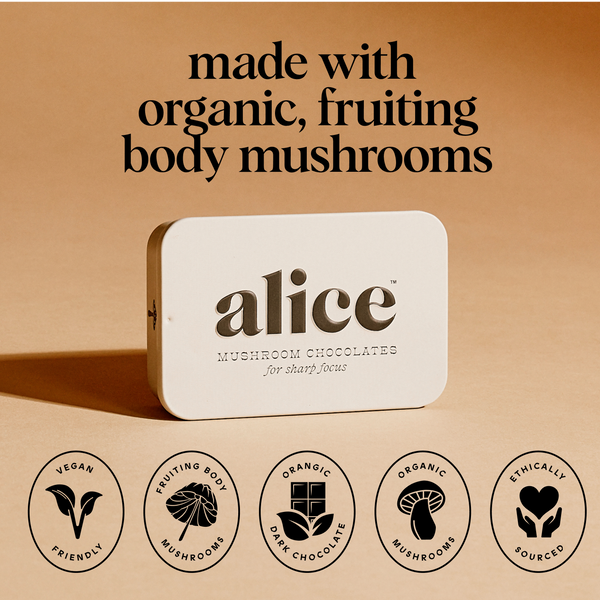
Brainstorm contains fairly traded organic dark chocolate, organic Lion’s Mane and organic Cordyceps from 100% fruiting body mushrooms, guarana and phosphatidylserine. Each square contains 66mg of natural caffeine which is equivalent to ⅔ cup of coffee.
Vegan, gluten-free, dairy-free, and OU-D kosher certified.
Other ingredients: organic semi-sweet 72% dark chocolate (organic unsweetened chocolate, organic cane sugar, organic cocoa butter), coconut oil, cocoa butter
Allergens: Coconut, Soy
Processed on shared equipment and may contain peanuts, tree nuts, milk, eggs, or soy.
Each bite of Brainstorm is formulated to boost cognitive function while also delivering an immediate boost to productivity and energy levels.
The long term benefits come from our functional mushrooms. Lion’s Mane and Cordyceps are felt over time — not instantly. When incorporated into a daily routine, the mushrooms’ nutrients compound in your body and become more effective (and noticeable) with sustained use.
Cordyceps works to boost blood oxygen levels to increase full body stamina, vitality, and energy. Lion’s Mane directly stimulates the nerve growth factor to improve memory, cognition, neuroplasticity, and brain health.
We also know that nothing beats instant gratification. That’s why we’ve added Guarana and Phosphaditylserine to our formula. Guarana is a caffeinated Brazilian berry that provides a smooth flow of energy, and Phosphaditylserine is a fatty acid that improves alertness, reaction time, thinking speed, and productivity throughout the day. Each square contains 66mg of natural caffeine which is equivalent to ⅔ cup of coffee.
The result: an indulgent daily routine that’s good for you and only gets better with time.
What to expect:
- In 30 minutes, feel productive and energized
- In 30 days, notice daily flow states, sustained energy and mental clarity
- After 3 months, enjoy memory support, brain health, and daily energy
One square suits most.
Enjoy one dose of Brainstorm when you’re in need of a clean boost of energy. Those looking for a stronger, more prolonged sensation may enjoy a double dose.
With daily use, Brainstorm supports neural connections in your brain for better productivity over time.
We exclusively use organic, fruiting body Lion’s Mane and Cordyceps mushrooms that are hand-harvested when their medicinal compounds are at peak concentration. Our mushrooms are dried in the sun to soak up Vitamin D before undergoing a pure, starch-free extraction process.
All ingredients are third-party lab tested for safety and stability, and mushrooms are third-party lab tested for potency.
