featured
Cordyceps: The Energy Mushroom
Energy without the jitters. Meet cordyceps—the energy mushroom that may support steady stamina and cellular energy, without the crash.

Cordyceps: The Energy Mushroom
Historically, cordyceps have been used in Chinese and Tibetan medicine in environments where the body was under real physical stress: high altitude, limited oxygen, and long days that were physically demanding. In these regions, survival required efficiency. Energy couldn’t be wasted, and recovery mattered just as much as output.
Cordyceps were traditionally used to help the body adapt to stress, particularly when oxygen was scarce. Rather than acting as a stimulant, they were valued for supporting endurance and resilience, helping energy last longer when conditions were harsh.
The problem today isn’t that we’re tired. It’s that we’ve been taught to ignore the signals telling us why we’re tired.
We’ve normalized overstimulation as a solution. Stress relief as a tool. Borrowing our energy from tomorrow as the price of productivity today. What we often call “energy” is really just the nervous system being pushed harder and longer than it was designed to go.
Energy That Supports Hormones
Today’s energy comes from stacked caffeine: espresso shots layered with cold brew, pre-workout, a 2 p.m. energy drink meant to keep stress elevated far beyond it should naturally fall. Sugar used strategically; quick glucose spikes to stay sharp and alert, followed by crashes disguised as hunger, irritability, or brain fog.
It also comes from pushing through your natural circadian rhythm signals with blue light, late-night scrolling, and supplements that act as band-aids rather than support systems. What’s marketed is often just the endocrine system being asked to compensate, repeatedly. This still produces energy output, it just does so by creating debt.
Endocrine disruptors are so out in 2026.
A healthy endocrine system runs on rhythm. Stress rises in the morning to help the body wake and mobilize, then gradually falls throughout the day to make room for focus, digestion, and eventually rest. Blood sugar fluctuates within a relatively narrow range to fuel the brain and muscles without triggering stress responses. When these signals stay intact, energy feels steady. When they’re overridden, the body compensates.
Most modern energy strategies rely on that compensation.
Hormone-balanced energy works differently. Energy isn’t something the body borrows, it’s something it produces. Every cell relies on mitochondria to convert oxygen and nutrients into ATP (the molecule that powers every muscle contraction to cognitive focus). When mitochondrial function and oxygen utilization are efficient, energy feels available and consistent. When they’re strained, the body leans on stress and adrenaline to maintain performance.
Much of what we experience as “energy” is stress doing the heavy lifting. That’s why ingredients like cordyceps, studied for how they support cellular energy production, matter now more than ever.
So What Exactly Are Cordyceps?
Cordyceps are functional mushrooms native to high-altitude regions of Asia, particularly the Himalayas (around 14,000 ft above sea level), where oxygen levels are low and environmental conditions are extreme. In these environments, organisms must adapt to limited resources and prolonged physical demand.
That evolutionary context helps explain why cordyceps have been associated with stamina and endurance. They developed in conditions where efficiency wasn’t optional, it was just survival.
There are hundreds of Cordyceps species, but modern wellness formulations primarily use Cordyceps militaris, a variety researched for its bioactive compounds, including cordycepin and polysaccharides. These compounds are associated with how the body supports energy metabolism at a cellular level.
Unlike simulants, cordyceps don’t work by activating the nervous system. Instead, they’re associated with supporting oxygen utilization and ATP production – the foundational processes behind sustainable energy. Stimulants create energy by asking the body to override fatigue signals. Cordyceps work upstream, supporting the systems that make energy available in the first place.

Energy vs Stimulation
The difference between energy and stimulation is subtle, but once you feel it, you can’t un-feel it.
Stimulation is a nervous system overload. It’s sharp, fast, and immediate. It can feel like tunnel focus, out of body, with a little edge. Sometimes it’s productive and can “help” you lock in focus. But more often it’s just your body interpreting “more input” as “more output.” That’s why stimulation often comes with side effects that aren’t really side effects - they’re signals: jitteriness, racing thoughts, appetite is off, an anxious wave that runs through your body, and the classic comedown shortly after.
Energy works at the cellular level. Every cell produces ATP, the molecule that powers movement, focus, and endurance. When this system is supported, energy feels more available and steady.
Stimulants help you access energy, they don’t necessarily help you produce it.
Cordyceps fall into the second category. Rather than forcing stimulation, they’re known for supporting oxygen utilization and cellular energy production, which are the processes that help energy last. Over time, that can feel like fewer crashes, less afternoon fatigue, and energy that lasts into the evening without disrupting sleep.

Cordyceps at alice
At alice Mushrooms, cordyceps are a foundational ingredient. Not because they promise instant energy, but because they support the systems that energy depends on.
In Brainstorm, cordyceps help support sustained mental energy alongside ingredients for cognitive function and stress adaptation. The result is focus that holds without tipping into overstimulation or burnout.
In Party Trick, cordyceps act as the energetic backbone beneath mood and connection-supporting botanicals. While other ingredients work across serotonin, dopamine, and GABA pathways to support social ease. Cordyceps help energy feel present and social, without borrowing from the next day.
In Happy Ending, cordyceps support stamina and circulation as part of a broader approach to intimacy and sexual wellness. Rather than sharp peaks followed by quick drop-offs, energy feels supported and available, allowing lasting connection.
Across formulas, the role of cordyceps stays consistent: support energy production without the stress.
A Smarter Way to Think About Energy
The next era of wellness isn’t about doing more. It’s about doing things differently. Energy doesn’t need to be hacked or forced. It needs the right conditions. When sleep, nutrition, movement, and stress signals are supported, the body already knows how to generate energy on its own.
Cordyceps don’t change who you are or how you feel. They support the systems that allow your body to do what it’s designed to do; produce energy efficiently, without relying on stress to carry the load.
Over time, that means fewer spikes, steadier endurance, and energy that holds up across real-life demands. Not just workouts or nights out, but workdays, conversations, and everything in between.
Energy without the crash.

Disclaimer: This blog contains promotional content about our products. The information provided is for educational purposes only and is not intended to diagnose, treat, cure, or prevent any disease. These statements have not been evaluated by the Food and Drug Administration. This content is not a substitute for medical advice. Always consult your healthcare provider before making changes to your wellness routine, especially if you are pregnant, nursing, taking medication, or have a medical condition.
References:
- Cleveland Clinic. (2023). Cordyceps Is a Killer Fungi With Potential Health Benefits. Retrieved from https://health.clevelandclinic.org/cordyceps-benefits
- National Library of Medicine. (2011). Cordyceps as an Herbal Drug. Retrieved from https://www.ncbi.nlm.nih.gov/books/NBK92758/
- Time Magazine. (2023). No, You Shouldn’t Be Afraid of Fungi. Retrieved from https://time.com/6256252/fungi-science-the-last-of-us/
- WebMD. (2024). Cordyceps - Uses, Side Effects, and More. Retrieved from https://www.webmd.com/vitamins/ai/ingredientmono-602/cordyceps
- Bon Appétit. (2017). How a Zombie Worm from Tibet Became an American Health Food Juggernaut. Retrieved from https://www.bonappetit.com/story/cordyceps-foraging-tibet?srsltid=AfmBOoopwoP84G4U9uR7aNJV9NA65qWJRa04SSlfxmmEzmBUAk1_h1bc
- Harvard Health Publishing (2024). Mushroom coffee: Worth a taste?. Retrieved from https://www.health.harvard.edu/nutrition/mushroom-coffee-worth-a-taste

By Kristen Carli, MS, RD
Kristen Carli is the owner of Camelback Nutrition & Wellness, a private nutrition practice and consulting firm. She graduated from University of Arizona with a BA in psychology and then received a BS in dietetics from Arizona State University. After completion of the dietetic internship, she continued her education by receiving a MS in Human Nutrition from University of Western States. Having a passion for nutrition communication, she writes for many food and nutrition outlets as well as regularly develops recipes for food brands and media companies. Her nutrition expertise has been featured in InStyle, Bustle, Livestrong, The List, MyFitnessPal and many others. Additionally, Kristen is often featured via local TV segments sharing nutrition tips and tricks. She was selected to act as a Produce for Better Health Foundation Fruit and Vegetable Ambassador in Action, helping to promote the health benefits and importance of consuming fruits and vegetables, as well as a FoodMinds upwaRD winner for 2022, honoring up and coming media dietitians. You can find her reading, running, and exploring new restaurants with her husband and baby boy.
save 15% with code alice15
Brainstorm










Brainstorm
Select Quantity:
Choose Your Price:

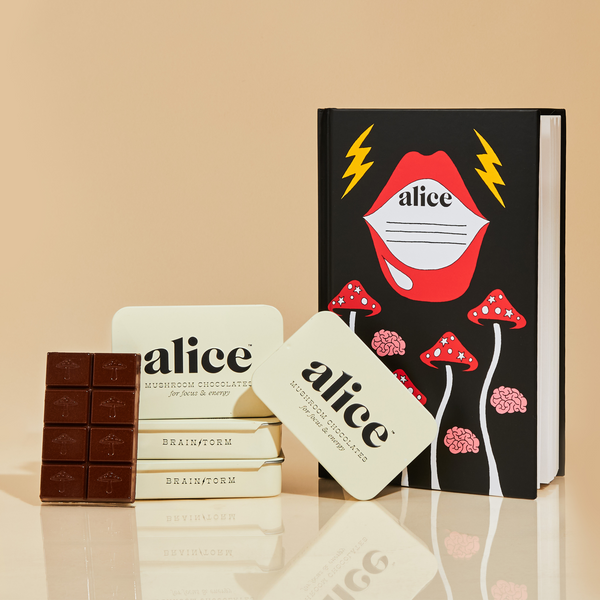
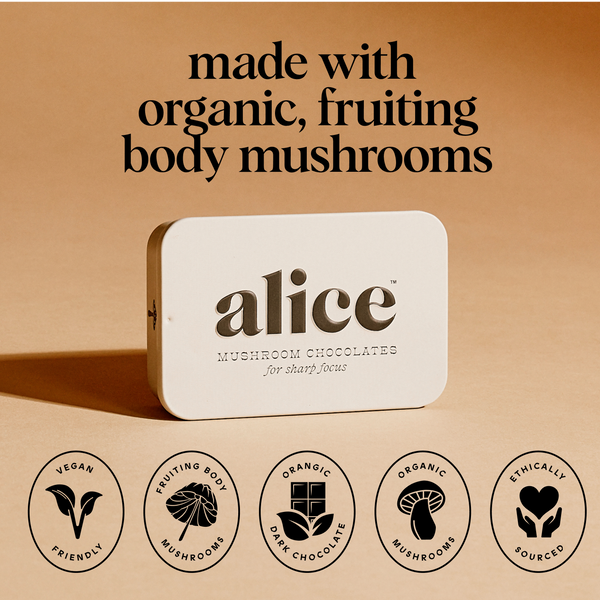
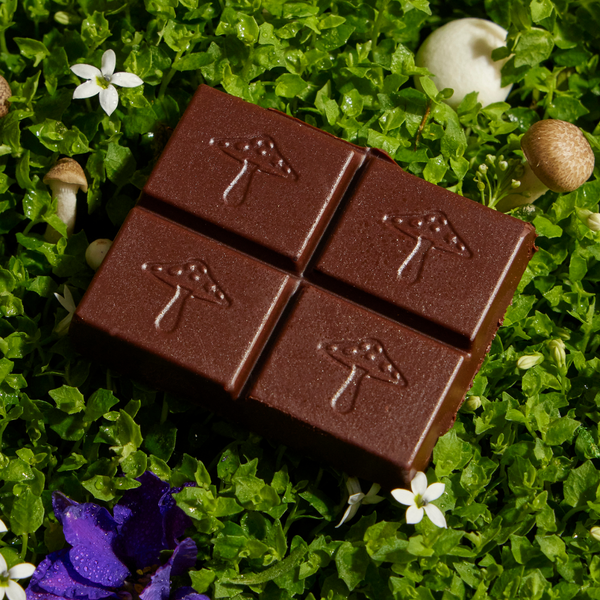
Brainstorm contains fairly traded organic dark chocolate, organic Lion’s Mane and organic Cordyceps from 100% fruiting body mushrooms, guarana and phosphatidylserine. Each square contains 66mg of natural caffeine which is equivalent to ⅔ cup of coffee.
Vegan, gluten-free, dairy-free, and OU-D kosher certified.
Other ingredients: organic semi-sweet 72% dark chocolate (organic unsweetened chocolate, organic cane sugar, organic cocoa butter), coconut oil, cocoa butter
Allergens: Coconut, Soy
Processed on shared equipment and may contain peanuts, tree nuts, milk, eggs, or soy.
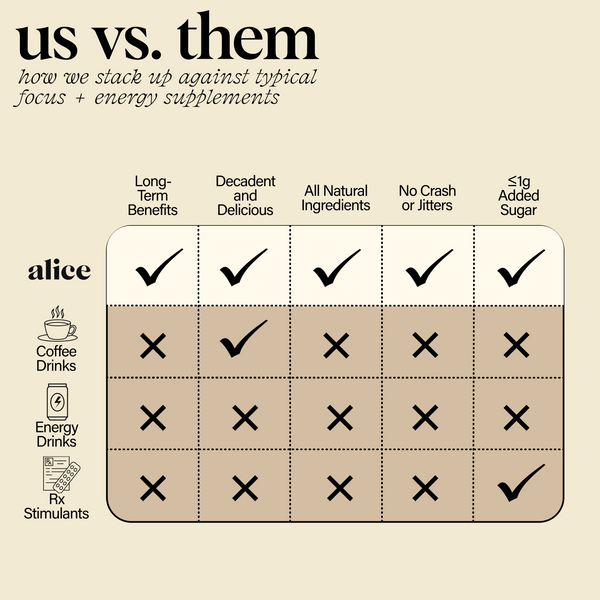
Each bite of Brainstorm is formulated to boost cognitive function while also delivering an immediate boost to productivity and energy levels.
The long term benefits come from our functional mushrooms. Lion’s Mane and Cordyceps are felt over time — not instantly. When incorporated into a daily routine, the mushrooms’ nutrients compound in your body and become more effective (and noticeable) with sustained use.
Cordyceps works to boost blood oxygen levels to increase full body stamina, vitality, and energy. Lion’s Mane directly stimulates the nerve growth factor to improve memory, cognition, neuroplasticity, and brain health.
We also know that nothing beats instant gratification. That’s why we’ve added Guarana and Phosphaditylserine to our formula. Guarana is a caffeinated Brazilian berry that provides a smooth flow of energy, and Phosphaditylserine is a fatty acid that improves alertness, reaction time, thinking speed, and productivity throughout the day. Each square contains 66mg of natural caffeine which is equivalent to ⅔ cup of coffee.
The result: an indulgent daily routine that’s good for you and only gets better with time.
What to expect:
- In 30 minutes, feel productive and energized
- In 30 days, notice daily flow states, sustained energy and mental clarity
- After 3 months, enjoy memory support, brain health, and daily energy
One square suits most.
Enjoy one dose of Brainstorm when you’re in need of a clean boost of energy. Those looking for a stronger, more prolonged sensation may enjoy a double dose.
With daily use, Brainstorm supports neural connections in your brain for better productivity over time.
We exclusively use organic, fruiting body Lion’s Mane and Cordyceps mushrooms that are hand-harvested when their medicinal compounds are at peak concentration. Our mushrooms are dried in the sun to soak up Vitamin D before undergoing a pure, starch-free extraction process.
All ingredients are third-party lab tested for safety and stability, and mushrooms are third-party lab tested for potency.

Happy Ending



Happy Ending
Select Quantity:
Choose Your Price:
Happy Ending contains fairly traded organic dark chocolate, Cordyceps from 100% fruiting body mushrooms, ashwaganda, maca, h-goat weed, munuca, damiana, tribulus, cayenne pepper and ceylon cinnamon.
Vegan, gluten-free, dairy-free, and OU-D kosher certified.
Other ingredients: organic semi-sweet 72% dark chocolate (organic unsweetened chocolate, organic cane sugar, organic cocoa butter), coconut oil, cocoa butter
Allergens: Coconut
Processed on shared equipment and may contain peanuts, tree nuts, milk, eggs, or soy.
Happy Ending is a chocolate made for sexual wellness, which provides immediate pleasure and arousal while improving sexual function for all genders with Cordyceps, ashwagandha, maca, h-goat weed, munuca, damiana, tribulus, cayenne pepper and ceylon cinnamon. We recommend taking 1 square daily for your sexual health and 2 (or more 🌶) when you're looking to get in the mood 😍
Happy Ending isn't only for sexual arousal and intimacy! We actually designed it to be a daily supplement to promote hormonal balance and overall sexual wellness.
What to expect:
- In 30 minutes, feel increased sensitivity and boost in mood
- In 30 days, notice heightened arousal, stamina, and increased blood flow
- After 3 months, enjoy deeper pleasure, enhanced libido, and greater satisfaction
We recommend taking 1 square daily to support overall intimate wellness and a healthy libido — it takes about 2-3 months of daily use to notice these full effects.
For heightened sexual pleasure in the moment, take 2-4 squares up to 1 hour before intimacy for immediate benefits from the aphrodisiacs.
We exclusively use organic, fruiting body Cordyceps mushrooms that are hand-harvested when their medicinal compounds are at peak concentration. Our mushrooms are dried in the sun to soak up Vitamin D before undergoing a pure, starch-free extraction process.
All ingredients are third-party lab tested for safety and stability, and mushrooms are third-party lab tested for potency.
Party Trick


feel-good feelings.
mushrooms
CHOCOLATE

per serving
1g of sugar
BASED
Party Trick
Select Quantity:
Choose Your Price:
Party Trick contains fairly traded organic dark chocolate, Cordyceps from 100% fruiting body mushrooms, kanna, gotu kola, l-taurine, and guayusa.
With less caffeine than a sip of green tea, you can enjoy the party and get a full night’s rest.
Gluten-free and OU-D kosher certified.
Other ingredients: organic semi-sweet 72% dark chocolate (organic unsweetened chocolate, organic cane sugar, organic cocoa butter), carbonated popping rocks (cane sugar, lactose [MILK], corn syrup solids, cocoa butter, and powdered sugar (non-GMO))
Allergens: Milk
Processed on shared equipment and may contain peanuts, tree nuts, milk, eggs, or soy.
*Please note that Party Trick specifically contains traces of milk chocolate within the popping rock candy coating and is NOT dairy-free/vegan like our other products
Party Trick is a sober-friendly chocolate filled with popping rock candy! It's made with powerhouse mood-boosting and energizing ingredients like Cordyceps, kanna, l-taurine, gotu kola, and guayusa so you can get that buzzy social feeling without alcohol or mind-altering substances. No hangover, no impairment, all party 🎉
While we created Party Trick to be a sober-friendly supplement, it can also be taken alongside alcohol to amplify your experience.
Party Trick is designed to target your serotonin, dopamine, and GABA receptors — the three neurotransmitters that shape mood, confidence, and connection. With naturally energizing ingredients (but less caffeine than a sip of green tea), each bite is designed to fuel you through whatever the night entails.
What to expect:
- In 30 minutes, feel elevated mood, social butterfly energy
- In 30 days, notice feelings of joy, social stamina, and l-dopa support
- After 3 months, enjoy better, balanced mood, stress resilience, and vitality & social ease
You can take up to 4 squares a night (or day, depending on how you like to party!) — we recommend starting with 1-2 squares, then keep enjoying as the night progresses.
You can expect effects to wear off about an hour after your last dose.
Enjoy 1 square daily for lifts to confidence, mood, and sociability.
We exclusively use organic, fruiting body Cordyceps mushrooms that are hand-harvested when their medicinal compounds are at peak concentration. Our mushrooms are dried in the sun to soak up Vitamin D before undergoing a pure, starch-free extraction process.
All ingredients are third-party lab tested for safety and stability, and mushrooms are third-party lab tested for potency.
mushrooms
CHOCOLATE
per serving
1g of sugar
BASED